


On the surface, there isn't much resemblance between the "neighborhood" that the members of Arcade Fire sing about and the neighborhoods most of us grew up in. Wayne Butler, the band's lead singer, grew up in a Mormon community in Texas, to a family that, while living in a devout religious setting, was also part of a lineage of liberal musicians and boundary-pushing.
In the suburbs of Texas in the 80s, there probably weren't many signs that said "N Nach Nach Nachman Meuman," or air conditioners dripping on the street, or the same generic lottery building that looks the same in every neighborhood in Israel. And yet, when Butler and the members of Arcade Fire sing about the childhoods in the neighborhood - a strange magic happens. Suddenly, their neighborhood becomes every neighborhood, anywhere in the world.
The foundations of this charm can be understood from a late quote by Butler: "They suggested I move to Montreal, I knew nothing about it, but I knew it was as far away from Texas as you could get, and that was enough." Even if we change the names of the cities, anyone who grew up in a small, stuffy place and learned to regard themselves as an exception will recognize the strong desire to escape to spaces of new possibilities where you can reinvent yourself. Montreal was the perfect place. A city where different cultures and languages mix. There, one evening, Butler arrived at a jazz band performance. The lead singer hypnotized him. The daughter of immigrants who fled Haiti, a jazz singer who also sang in medieval music ensembles and taught herself to play any instrument she encountered. Her name was Régine Chassanne. They quickly became a couple, and also the beating heart of Arcade Fire. The band gradually became a kind of musical commune, musicians changed, each pouring his cultural world into a sound monster with influences ranging from Neil Young and Dylan, to New Order and the Smiths, through Claude Debussy, to Caribbean music from the shores of Haiti. If a particular song only needed two guitars, the third guitarist grabbed a can and drummed on it with a screwdriver. Each layer added enriched the texture of the sounds and integrated into one clear artistic statement. They sounded as if a dam had burst and behind it a tsunami of deep emotions and memories from different periods in history had erupted at once.
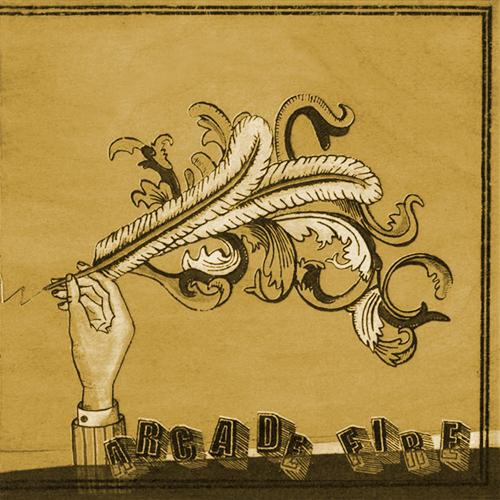
When it came time for their first album, Arcade Fire had experienced a series of losses. That same year, four of the band's members, including Butler and Shasan, lost close family members. This is how their debut album received the morbid name: Funeral. But from the very first song on the album, it becomes clear that the funeral that Arcade Fire sings about is not just a ceremony of sadness and loss. It is an opportunity for a sober look, and an exit to a new life. "A funeral is an experience that allows for such a deep connection to the important things in life." Shasan said, "This experience led us to a great outburst of inspiration, looking at life through its end point enriched us."
And not just them. When the album was released, in September 2004, Arcade Fire's burst of inspiration, from neighborhood memories to anthems of teenage rebellion to coming to terms with the cycle of life, caught listeners around the world by surprise and pounding their hearts. They sounded like everything and nothing else. A memorable review of the album in Pitchfork magazine stated: "We live in a generation in a time of alienation. We've already forgotten that the word emo originally comes from the word emotional. It's taken so long to get to the point where an album manages to restore the word emotional to its original meaning that it feels irrelevant to analyze clinically how exactly they got there. What matters is the simple comfort of knowing that we got there."
In 2024, it's hard to listen to Arcade Fire with the same admiration. The harsh accusations against Wayne Butler of sexual misconduct and abuse of his position with fans cast his messages of hope in a completely different light. It's harder for us, in our daily reality, to escape the ground and cling to naive optimism.
But even now, when the drum beats and guitars of Wake Up begin to play in the background, as we enter with Arcade Fire on their journey through the neighborhood, there is some inner child that has come back to life and wants to come out. To a new life, with new hope for the future. On the 20th anniversary of the album, Noga Klein returns to 2004 and to these naive feelings in a special program.